
A different conversation from a catalogue order
A custom part has no price until the drawing exists. What we can give you quickly is a feasibility answer: whether the part can be made as drawn, what would need to change if not, and what the route to production looks like. Our supplier partner handles technical review, drawing review, prototyping and die creation, and we stay accountable for the whole thing from your first message to repeat supply.
- We supply and coordinate manufacture. We are not the factory, and we will not pretend to be.
- Every part starts with a drawing review, because most quoting delays are ambiguity, not capacity.
- Prototype first, tooling second, production third. We do not skip the first article.
- If a part is beyond what our supply base can support, we say so up front and point you elsewhere.
- Repeat supply runs against an approved sample, so what you signed off is what you keep receiving.
 Made to Drawing
The Process
From drawing to part, in five stages
Each stage has one thing you send and one thing you get back. No stage starts before the previous one is signed off.
Send a drawing, a sketch or a physical sample. We confirm we have understood it and come back with questions wherever it is ambiguous.
With material, quantity, tolerance and finish confirmed, you get a clear yes, a yes with suggested changes, or an honest no.
On your approval to proceed, a physical first article is produced so you are judging a part, not a drawing.
Once the prototype is signed off, tooling or dies are made and proved out before any production quantity is committed.
Repeat supply runs against the approved sample, with the same point of contact you started with.
What We Need
What to include so we can quote
A dimensioned drawing, a CAD file, or a physical sample we can measure. A photograph alone is rarely enough.
Grade, not just family. “Stainless” covers alloys that machine and cost very differently.
One-off, prototype batch, or repeat production. This changes the process, the tooling decision and the price more than anything else.
Which dimensions are critical and which are nominal. Blanket tight tolerances raise cost without improving the part.
Plating, painting, anodising, passivation or as-machined, and any roughness requirement.
Hardening, tempering, normalising or none, with the target hardness if it matters.
Dimensional report, material certificate, or first-article inspection. State it now, not after delivery.
When you need the prototype and when you need production. Tooling lead time is usually the constraint.
Part Types
What we can take on
General machined parts to drawing, in carbon steel, stainless, brass and aluminium.
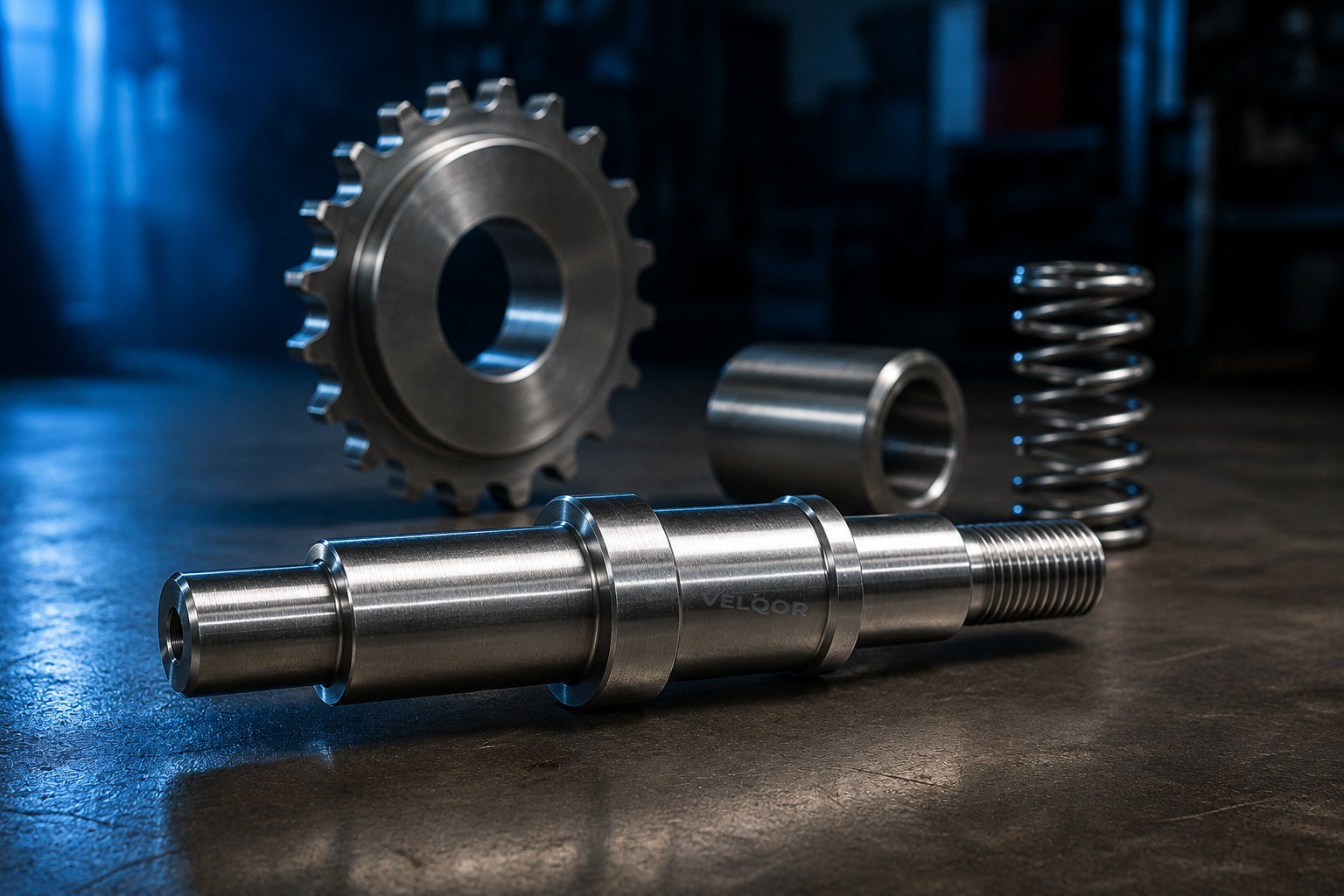
Drive components including shaft and sprocket assemblies for machinery and conveying equipment.
Steel rollers and roller wheels for conveying and handling equipment.
Compression and formed springs, including stainless grades.
Formed heating coils and related elements for process and industrial equipment.
Multi-part fabricated and welded assemblies built to your drawing.
RFQ Checklist
What to send us
Send what you have. Missing items are what the drawing review stage is for.
Custom Precision Parts — Frequently Asked Questions
Do you manufacture these parts yourselves?
No, and we will not claim otherwise. Velqor supplies and coordinates manufacture through a supplier partner who handles technical review, drawing review, prototyping and die creation. What we are accountable for is the specification being right, the process moving, and you getting a straight answer at every stage.
How is this different from your Custom Valves and Custom Fittings pages?
Those two cover parts that are still a valve or still a fitting, just not a catalogue one. This page is for parts that are not a valve, fitting or hose at all. If you need a non-standard port thread on a ball valve, start with Custom Valves. If you need a shaft, a roller or a bracket, start here.
Can you quote from a photograph?
Rarely. A photograph tells us what the part looks like, not what it has to do or how accurately. We can often identify the part type and start a useful conversation from a photo, but a firm quotation needs dimensions, material and tolerance.
What is the minimum quantity?
There is no fixed minimum, but the economics change sharply. A one-off is machined and priced as a one-off. A part that needs a die or tooling only makes sense once the quantity justifies the tooling cost, and we will tell you where that line falls for your part rather than quoting tooling you do not need.
Will I get a sample before production?
Yes, that is the intended route. A prototype or first article is produced and signed off before tooling is committed and before any production quantity is run. Skipping it is possible on simple parts but we will advise against it.
What if the part cannot be made as drawn?
You get told, with the reason and with what would need to change. That is a normal outcome of the feasibility stage and it is far cheaper than discovering it after tooling. If the change is not acceptable to you and we cannot support the part as drawn, we will say so and point you towards someone who can.
Do you handle tooling and die costs separately?
Tooling is quoted as its own line so you can see what you are paying for and what it buys you. It is not buried inside a per-piece price, because that makes the second order look inexplicable.
How quickly can you respond?
We aim to acknowledge and come back with questions or a feasibility view within one business day. A firm quotation depends on the part, and we will tell you when to expect it rather than leaving you to chase.