
Levelling and vibration isolation are two different jobs
A levelling foot puts a machine’s support points on the same plane so the bed is not twisted and the machine holds its geometry. An anti-vibration mount does that too, but adds a resilient element that decouples the machine from the floor so its vibration is not transmitted into the slab, and into whatever else is standing on it.
- Levelling only: a rigid foot sets the plane. Nothing is isolated.
- Levelling plus isolation: a bonded elastomer element deflects under load and breaks the structure-borne path into the floor.
- Isolation is a function of deflection, not of the word “rubber”. Ask any supplier for deflection at rated load.
- Free-standing installation avoids drilling the slab and keeps the machine relocatable.
- No product standard governs how a levelling mount is load-rated. Every figure in this category is manufacturer-declared.
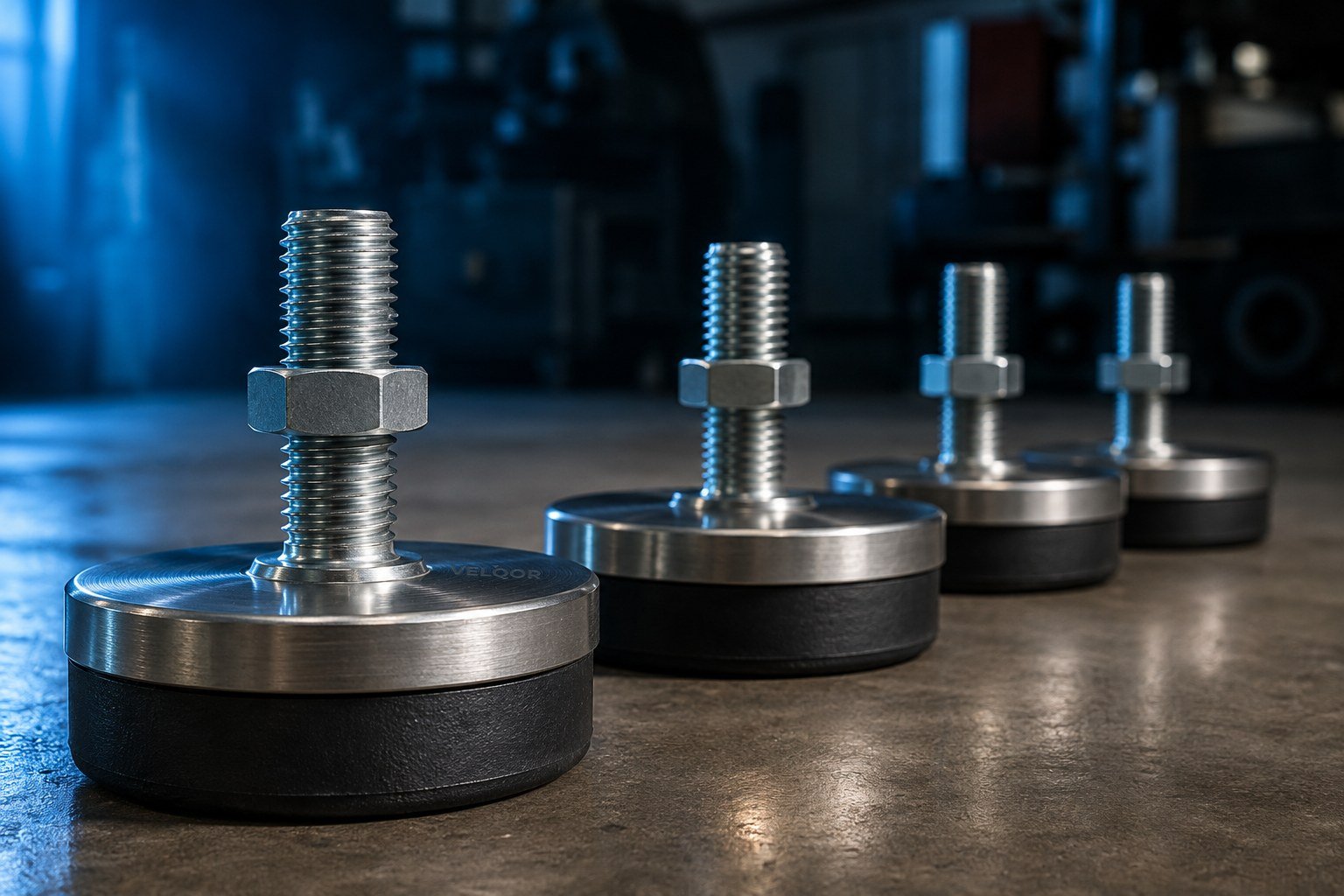 Anti-Vibration Levelling Mounts
Types in this family
Four types, four different jobs
Tell us the duty and we will confirm what we can support against your specification before quoting. If a type sits outside our supply base, we will say so up front.
A steel top with a bonded elastomer element. Levels and isolates in one part. The general-purpose choice for machine tools, presses and packaged plant.
Two or three inclined blocks driven by an adjustment screw. High load capacity, fine and lockable adjustment, negligible settling. Used where geometry has to hold.
A threaded stud into a plain or swivelling base. The articulating type sits flat on a floor that is not square to the stud, which keeps bending load out of the stud.
Ribbed or waffle elastomer plate with no threaded element, cut to size and placed under an existing foot. The cheapest way to break a structure-borne path.
Specification
What we need you to state
Static plus dynamic, and the real distribution. Four points rarely share a load equally. Undersizing and oversizing both degrade isolation.
ISO metric coarse or UNC to ASME B1.1. They share a 60° flank angle and are not interchangeable. State which one.
Stud length sets the levelling range. State the height you need to make up and whether the setting has to lock.
Drives floor bearing pressure. A small base on a weak or epoxy-topped slab will punch in and lose level.
Zinc-plated steel, stainless or cast. The stud can differ from the base. State the environment, not only the material.
NBR, EPDM, neoprene or natural rubber, with hardness in Shore A to ISO 48-4 or ASTM D2240. Oil resistance is tested to ISO 1817.
State the range at the mount, not the ambient in the building. Elastomer properties move with temperature.
Free-standing, bolt-on, bolt-through or clamped. A bare bolt through a resilient mount short-circuits the isolation unless isolating washers and tubes are used.
Applications
Where these get used
Lathes, mills and machining centres, where a twisted bed shows up directly as lost geometry.
High impact loads and a strong tendency to walk. Load rating and anti-slip both matter.
Continuous cyclic motion with oil and coolant present. Elastomer choice is the decision that matters.
Rotating plant where the complaint is usually noise and vibration reaching offices or neighbours.
Long runs of lighter equipment on uneven floors. Articulating feet earn their place here.
High dynamic force on a shop floor. Heavy-duty or wedge mounts, not general-purpose feet.
RFQ Checklist
What to send us
You do not need all of it. The first four get you a useful answer.
Levelling Pads — Frequently Asked Questions
What is the difference between levelling feet and anti-vibration mounts?
A levelling foot sets the machine on a flat plane. An anti-vibration mount does that and adds a resilient element that deflects under load, breaking the structure-borne path into the floor. A rigid foot sold as “anti-vibration” is a spacer. The honest test is whether the supplier can state deflection at rated load.
How do I work out the load per mount?
Start with total machine weight divided by the number of support points, then correct for the fact that the load is rarely shared equally, and add any dynamic or impact load. Isolation performance depends on the mount working within its intended load band, so a mount that is far too large is as poor a choice as one that is overloaded.
Is it “levelling pads” or “leveling pads”?
Both. “Levelling” is UK and EU usage, “leveling” is North American. You will also see machine mounts, levelling feet, levelling elements, machine feet and anti-vibration pads used for overlapping parts of the same family. Tell us what the part has to do and we will work out which one you mean.
NBR or EPDM — which elastomer should I choose?
NBR resists oil and coolant but degrades under UV and ozone. EPDM survives outdoors but swells badly in oil. No single compound wins both, so the choice follows the environment. Resistance is tested to ISO 1817. If you have oil at floor level and the mount is outdoors, tell us, because that combination needs a deliberate decision rather than a default.
Do I have to bolt the mounts to the floor?
Often not. Free-standing installation avoids drilling the slab, reduces install time and keeps the machine relocatable, which is why many machine tools sit on friction-faced mounts. Where anchoring is required, note that a bare bolt passing through a resilient mount creates a rigid path straight into the floor and cancels the isolation, so isolating washers and tubes are part of the specification, not an accessory.
Which standard governs the load rating?
None. There is no ISO, EN or IS standard that specifies levelling mounts as a product, so every load figure in this category is manufacturer-declared. What is standardised is the testing around them: ISO 10846 for how a resilient element’s transfer properties are measured, ISO 48-4 and ASTM D2240 for Shore hardness, ISO 1817 for the effect of liquids on rubber, and ISO 20816 for machine vibration on rigid versus flexible supports.
Why does my machine keep moving across the floor?
Horizontal forces during normal operation walk a machine progressively in one direction. It usually means the mounts have no friction element, the base is hard and smooth against a smooth floor, or the mounts are overloaded and no longer deflecting as intended. Bonded elastomer faces, ribbed or waffle patterns, or anchoring are the usual fixes, and which one is right depends on whether you also need isolation.
Can you supply stainless or food-grade levelling feet?
Stainless is a normal request and we will quote it against your specification. Certified hygienic feet carrying 3-A, EHEDG or USDA approval are a different matter. We have not identified an Indian manufacturer holding those certifications, so if your plant audit requires certified hygienic feet we will tell you that up front and point you towards a European supplier rather than quote something that will not pass your audit.